


My rating: 2 of 5 stars
The Man with the Golden Gun (1965) by Ian Fleming was published posthumously, and some critics claimed the book had not been complete at the time of Fleming’s death in August of 1964, and had been completed by Kingsley Amis instead.


Regardless of this, Fleming was in poor spirits and poor health prior to his death when he complained to John Betjeman, ”My inventive streak is very nearly worked out” (vi).
The Man with the Golden Gun is a mix between Fleming’s brilliance and his failing efforts while the film with Roger Moore in 1974 can be considered as a unique expression of this James Bond story, meaning there are no car chases in the book nor is there a shooting gallery and Bond doesn’t get rough with any of the female cast either.


No. For the most part the book, The Man with the Golden Gun, has a very simple plot and shows signs of Fleming’s creativity weakening by book’s end (or was Fleming dead by then?).

The beginning of this book, however, is as exciting as one might expect from a Bond novel. The world believes Bond is dead. He reemerges in London and makes some phone calls only to get ridiculed and laughed at. When the Secret Service begin to believe that this man might actually be the James Bond who was classified as ”missing believed killed”, they bring him in. Bond eventually explains his absence and his presence with the KGB and finds himself sitting in front of M.
‘James Bond had become tense. There was a whiteness round his lips. The blue-grey eyes still stared blankly, almost unseeingly at M. The words range out harshly, as if forced out of him by some inner compulsion. ”It would be a start if the warmongers could be eliminated, sir. This is for number one on the list.”


‘The hand, snub-nosed with black metal, flashed out of the pocket, but, even as the poison hissed down the barrel of the bulb-butted pistol, the great sheet of Armourplate glass hurtled down from the baffled slit in the ceiling and, with a last sigh of hydraulics, braked to the floor. The jet of viscous brown fluid splashed harmlessly into its centre and trickled down, distorting M’s face and the arm he had automatically thrown up for additional protection’ (p 19-20).
That’s right. The KGB had brainwashed Bond (who is to say where Bond’s lover, Kissy Suzuki, and her child have gone from the previous book?) and Bond attempted to assassinate M.


M, albeit outraged, orders Bond to a special hospital to be un-brainwashed and then orders for Bond to prove his muster once more by killing the lone gunman, Paco ‘Pistol’ Scaramanga. Either Bond is killed (problem solved) or Bond kills the man with the golden gun and proves he is loyal once more to M (problem solved). This opening (a do or die for James Bond) is very similar to the preceding novel, You Only Live Twice, where M sends Bond to Japan to kill a ”Collector of Death” in order to either get the ‘old’ Bond back or to get rid of the ‘new’ Bond, who is severely depressed, once and for all. Despite this coincidence, M once more sends Bond to his ultimate destruction. Bond heads to Jamaica, Fleming’s own residence for much of his life. And this is where the story begins to sag.


Bond lands in Jamaica to find that Miss Goodnight has been stationed there. They hit off their old flame and Bond is soon on the hunt for this Scaramanga fellow. Bond gets a tip and heads to a whore house at No. 31/2 Love Lane, where he meets Tiffy. Here, Fleming’s writing is as sharp as ever.
‘Good evening. Could I have a Red Stripe?’
‘Sure.’ She went behind the counter. She gave him a quick glimpse of fine bosoms as she bent to the door of the icebox — a glimpse not dictated by the geography of the place. She nudged the door shut with a knee, deftly uncapped the bottle and put it on the counter beside an almost clean glass. ‘That’ll be one and six’ (p 59).


Here’s where things go south real quick. Scaramanga just so happens to be in the neighborhood (okay, I can believe it) and gets buddy-buddy with Bond over some beer (okay, starting to lose me) and, although Scaramanga has just killed a spy sent after him and knows MI6 is after him, Scaramanga quickly decides to hire Bond for a thousand dollars and have Bond become his ally and confidant. Together Bond and Scaramanga head to a ruined resort, owned by Scaramanga and his partners, gangsters from round the world. Bond has been sent to kill Scaramanga and has his chance as he sits behind the man in the car, and Bond decides to do nothing (okay, that lost me).
Not much else happens after page 68. One of the best scenes by far (in Chapter 5) is when Bond is in the bar with Tiffy and Scaramanga. But thereafter it is all downhill for this story. Bond becomes an event manager for the secret villains and listens through the door by using a drinking glass while the CIA and Bond’s own friend, Felix Leiter, is working for the struggling resort and has bugged the conference room.


One of the few scenes that does stand out towards the book’s end is when Bond and the evil villains are having a wild party.
‘The service door sighed. A glistening figure slipped through and, after pausing in the darkness, moved into the pool of light round the hand with a strutting jerk of belly and limbs. There was Chinese blood in her and her body, totally naked and shining with palm oil, was almost white against the black hand. As she jerked round the hand she caressed its outstretched fingers with her hands and arms and then, with well-acted swooning motions, climbed into the palm of the hand and proceeded to perform langorous, but explicit and ingenious acts of passion with each of the fingers in turn… [and much later] The climax to what could certainly class as an orgy was clearly in sight’ (p 120-122).

Things are wrapped up fairly quickly after that. Scaramanga, now aware who Bond is, schedules a train ride to the coast where he plans to kill Bond. Felix blows up a bridge to stop the train. Bond and Scaramanga have a gun fight on the train where many of the gangsters are shot sitting in their seats. Bond and Felix, believing everyone dead, jump from the train minutes before it plunges into the ravine. Scaramanga, however, is only wounded and manages to escape. Bond goes on the hunt to find Scaramanga gravely wounded, or so Bond thinks, slumped against a tree. Bond and Scaramanga have their final moment.


If Fleming felt his ‘inventive streak’ was not what it once was, I can only agree with him. The Man with the Golden Gun is inferior to its predecessor You Only Live Twice, published only a year before, and nothing compared against that champion of a novel, Casino Royale that was published twelve years prior.

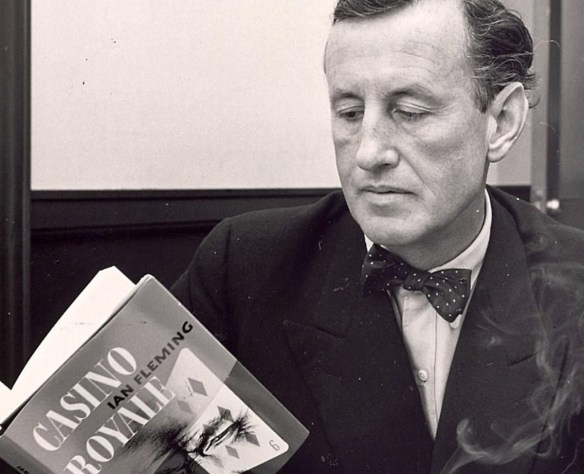
Nevertheless, The Man with the Golden Gun, for me, was a bit disappointing overall. The book ends much the way You Only Live Twice, with Bond unable to return his love to a woman.


‘At the same time, he knew, deep down, that love from Mary Goodnight, or from any other woman, was not enough for him. It would be like taking ”a room with a view”. For James Bond, the same view would always pall’ (p 200).


What this book does offer is some of Fleming’s sharp, clean prose and his ability to bring a scene to life like none other. The scenes with M at the beginning, with Tiffy at Love Lane, the wild orgy, and the final dual between Bond and Scaramanga are as good as most writers want to be, but the real drag is what lies in the gaps in the overall plot, which seems to fade like a whimper than to shout with a bang.
Overall, I recommend this book to Bond fans, but not for just any reader.

My rating: 2 of 5 stars
To be clear, the last Bond book by Ian Fleming is Octopussy (also nothing like the film) and The Living Daylights published in 1966.


This is not a self-contained novel. Rather, it is a set of short stories: 1) Octopussy; 2) The Property of a Lady; 3) The Living Daylights; 4) 007 in New York.


The collection of stories is a quick read at 130 pages. ”Octopussy” is probably a great story to see into Fleming’s day to day life while he lived in Jamaica.

”The Living Daylights” is an exemplary story, either for literary or for espionage, and I recommend this story above the four others. The worst story in this series is the last, ”007 in New York” and is not much of a story at all. Not really.


CG FEWSTON


American Novelist CG FEWSTON


This is my good friend, Nicolasa (Nico) Murillo, CRC, who is a professional chef & a wellness mentor. I’ve known her since childhood & I’m honored to share her story with you. In life, we all have ups & downs, some far more extreme than others. Much like in Canada, in America, the legalization of marijuana has become a national movement, which includes safe & legal access to cannabis (marijuana) for therapeutic use & research for all.
“This is a wellness movement,” Nico explains. The wellness movement is focused on three specific areas: information, encouragement, & accountability.
In these stressful & unprecedented times, it makes good sense to promote & encourage the state or condition of being in good physical & mental health.
To learn more you can visit: Americans For Safe Access & Texans for Safe Access, ASA (if you are in Texas).
The mission of Americans for Safe Access (ASA) is to ensure safe and legal access to cannabis (marijuana) for therapeutic use and research.
Link: https://www.safeaccessnow.org/
TEXANS FOR SAFE ACCESS ~ share the mission of their national organization, Americans for Safe Access (ASA), which is to ensure safe and legal access to cannabis (marijuana) for therapeutic use and research, for all Texans.
Link: https://txsafeaccess.org/about-1
Stay safe & stay happy. God bless.
Nico Murillo Bio ~ Americans & Texans for Safe Access ~ Medical Cannabis


